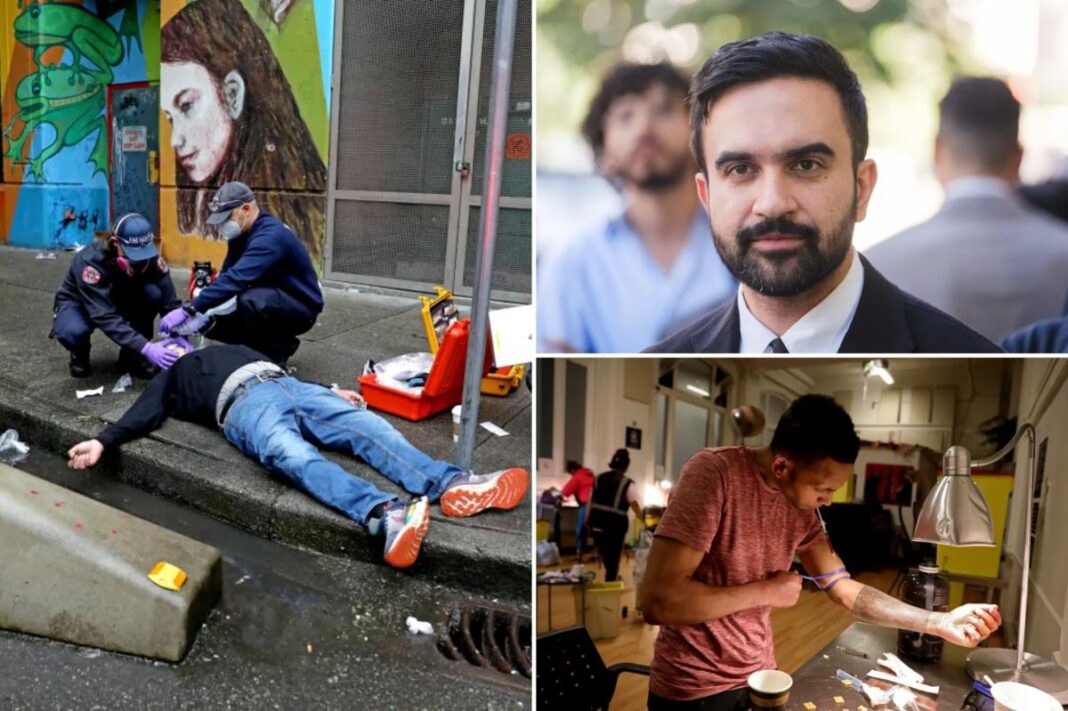

The premier of British Columbia — a Canadian province that’s a mecca of open-air drug use and supervised injection sites — has admitted decriminalizing drugs was a mistake.
“I was wrong on drug decriminalization and the effect it would have,” David Eby said at a Vancouver talk organized by the Urban Development Institute earlier this month. “It was not the right policy.
“What it became was a permissive structure that . . . it was okay to use drugs anywhere that resulted in really unhappy consequences.”
Despite touting drug decriminalization as a way to save lives, British Columbia is still the epicenter of the opioid crisis north of the border.
The public health emergency it declared back in 2016 over the alarming death toll has only worsened, despite the drug reforms put in place since.
Since the state of emergency was declared, more than 16,000 people have lost their lives to drugs in the liberal west coast province of 5.7 million people.
British Columbia decriminalized drugs in January 2023.
That year, 2,511 people — almost seven a day — died of drug overdoses, the most ever reported by the province’s coroner.
That’s 47 deaths per 100,000 people – compared to 32 for New York State that same year.
Despite this — and similar results in nearby Oregon which also rolled back drug decriminalization – the NYC chapter of the Democratic Socialists of America and their mayoral candidate, Zohran Mamdani, persist in using such drug-friendly jurisdictions as a model for the reforms they want to import to the Big Apple, critics told The Post.
“What they’re driven by is not the facts on the ground, but their ideology,” said Rafael Mangual, a public safety expert at the Manhattan Institute. “And their ideology is unflinching in the face of evidence that undermines the claims it’s pushing.”
The DSA touts drug decriminalization and the authorization of more supervised injection sites in their New York legislative platform.
One of Eby’s first moves after taking office in November 2022 was obtaining a federal exemption allowing anyone in B.C. to consume up to 2.5 grams of cocaine, crack, ecstasy, meth, heroin and even fentanyl in public spaces.
The government said fear of arrest deprived drug users of potential access to lifesaving services — and wanted to push them to consume in public where overdoses could be spotted.
Overdoses were so common that five men in their 20s who had overdosed on opioids on a Vancouver park bench were ignored by local cops.
Ironically, one OD death took place at an “overdose prevention site” — a government sanctioned shooting gallery.
Other terrifying reports emerged, like a new mother who smoked meth in her hospital room mere hours after giving birth.
Despite the backlash, Eby only agreed to walk back decriminalization slightly in April 2024, banning drugs in public areas but continuing to allow them in homes, shelters and government-sanctioned clinics.
The decriminalization wasn’t British Columbia’s only experiment with so-called harm reduction strategies. It opened North America’s first supervised injection clinic back in 2003 — almost two decades before New York City’s two sites — and now has as many as 50.
Since Vancouver opened that first “safe injection site,” overdose deaths have surged 996.5% in the province, from 229 to 2,511.
“When you decriminalize drug use, what you end up with is an increase in use,” said Mangual. “And if you’re going to lead to an increase in use, there’s no way you’re going to cut overdose deaths. If anything, it’s going to be the opposite.”
The province even pushed a so-called “safer supply program” that encourages doctors to prescribe opioids to drug addicts as a “safer” alternative to street drugs.
After first launching the effort in 2020, British Columbia doubled down by by expanding the list of drugs to include injectable fentanyl, “to better meet the needs of individuals with higher tolerance levels.”
In a government memo leaked earlier this year, the ministry of health admitted a “significant portion” of the supply was getting into the hands of transborder organized crime — something President Trump has denounced.
Since the program launched, annual opioid prescriptions exploded from 500,000 to 22.4 million doses – handed out to just 5,000 patients, an average 4,483 opioid doses per person each year.
Mamdani’s campaign did not respond to The Post’s request for comment.