ComingSoon Senior Editor Brandon Schreur spoke to The Testament of Ann Lee director Mona Fastvold about the historical musical drama movie. Fastvold discussed crafting the elaborate musical sequence scenes, why the movie couldn’t be made during the COVID-19 pandemic, and more.
“From award-winning writer-director Mona Fastvold (The World to Come, The Brutalist) comes the extraordinary true legend of Ann Lee, founder of the devotional sect known as the Shakers,” the synopsis reads. “Academy Award nominee Amanda Seyfried stars as the Shaker’s irrepressible leader, who preached gender and social equality and was revered by her followers. The Testament of Ann Lee captures the ecstasy and agony of her quest to build a utopia, featuring more than a dozen traditional Shaker hymns reimagined as rapturous movements with choreography by Celia Rowlson-Hall (Vox Lux) and original songs & score by Academy Award winner Daniel Blumberg (The Brutalist).”
The Testament of Ann Lee will be available on Digital March 10.
Brandon Schreur: I just want to start by asking about what drew you to this project, in general. What made you want to make a movie about Ann Lee and the Shakers, and what was ultimately the driving inspiration behind getting this made?
Mona Fastvold: Well, first, I was really excited to discover a story about this forgotten feminist American icon. It was a part of American history I knew very little about. It’s a very dark time in American history. And I didn’t know that there was this incredibly brave woman who immigrated from Manchester to America with just eight followers, and then they created the largest utopian society in American history. What a discovery.
For me, one of the reasons I really felt this needed to be a film — beyond the scope and the scale of her story, it felt like a great cinematic piece with crossing oceans. There’s drama, there’s action, and there’s so much to her story. But I was also so excited to discover that the Shakers worshiped through ecstatic song and dance. The challenge and the thrill of attempting to make this into my sort of strange kind of modern musical felt irresistible.
Sure, totally. You mentioned that you learned so much while making this. I felt like I learned so much, too, by watching it because I had heard of the Shakers, but I didn’t really know too much about them at all. So I thought this was really interesting and exposed me to a whole world I wasn’t aware of. So, bouncing off that, did your opinions of Ann Lee and the Shakers change at all when you were making this movie? Did you see the real-life Ann Lee in a different light or way when you were done compared to how you viewed her when you started making it?
My research period was very — I kept waiting for that moment in stories about religious leaders or political leaders where, all of the sudden, their priorities shift, and they start manipulating their surroundings to continue to hold onto power or to gain a greater group of followers. What surprised me was that, in Ann Lee’s story, that never happens. She’s always quite humble. It’s never about her. Never ego-driven. She’s always leading from a place of really wanting to create a safe community where everyone can live as equals. So I think that’s what surprised me the most.
Once I started making the film, after we finished the script, then you feel — you’re creating this fictional character. It separates from the real person. We had one day when we were shooting in the Hancock Shaker Village. Amanda was standing in the hallway. It was five in the morning, and there was snow falling outside. She was singing this one song, Stone Prison. I think we felt, all of us sort of felt, this strange, sort of ghostly connection to the past. Standing in those beautiful buildings, in that beautiful hallway, hearing these hymns and all of the sudden feeling a connection to the pain and the trauma that she endured. And all the beautiful things that she stood for that are still so incredibly important to fight for, now.
Totally. You mentioned the music, and that’s what I want to ask you about next. First of all, I was blown away by the musical scenes in here — I thought they were so good, and I loved the choice of using the hymns. At what point during the process of making this movie did you realize it was going to be a musical? Was that always the intention from day one, or did that come later on when you were working on the script?
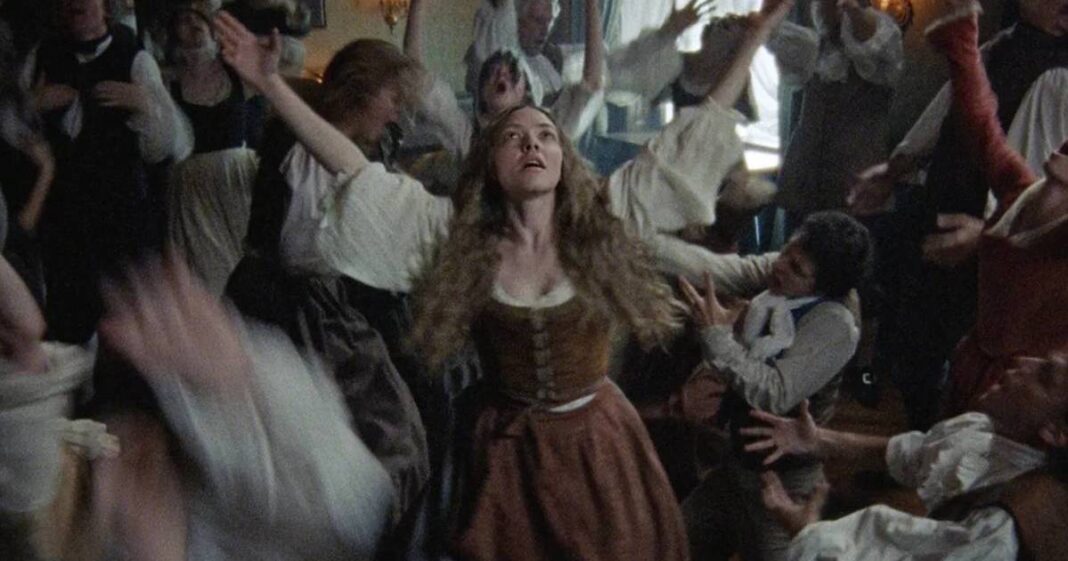
No, I knew that there had to be so much movement and music in the film because that’s how they worship, through ecstatic song and dance. They did leave behind almost 1,000 hymns. I knew that I had to incorporate the musical tradition as much as I had to incorporate their incredible craftsmanship, the architectural marvels that they created, the beautiful interior design, and their inventions. All of this had to be part of it and take equal parts of it.
Calling it a musical was something that I was hesitant to do for quite a while. I think modern musicals are so difficult, so hard, and so tricky. I couldn’t really bring in jazz hands — your mind goes there, and this could definitely not be that. I think I resisted the term, but after a while, in the process of writing it, I think I just had to accept that this was a full-on musical and that’s what we’re writing here.
Then it was exciting. It’s fun to give yourself a challenge. You have to be a little bit sacred. If you don’t feel scared, then what’s the point? You have to keep on pushing yourself.
Yeah. Again, I was blown away by those scenes, and I have to imagine they were not the easiest things to film. You have so many people in the background, so much choreography going on, and so many camera movements. Was there one of these hymns that was particularly challenging in this way? And is there also an unsung hero — someone who is part of the crew who had a big hand in making these musical numbers happened — that you can shoutout because they helped bring it to life?
Yes, I mean, they were all challenging in different ways. Some because we’d have 200 dancers in a small room with 500 burning candles. So, fitting all of us and the camera in the same space was challenging. I think the glue for these challenging dance numbers would be the ship, when we were filming in the rain and in a storm. Or, in the forest.
There were two people. Sam Ellison, our operator, who would come to rehearsals and was Will Rexer, my cinematographer’s right hand. He’s incredible. And, then, [Natalie Shinnick], who is also in the film. She plays the mother who suffers from postpartum depression. She dances through the whole film as well, but she was also a choreographer’s assistant. So, these two number two players, Natalie and Sam, I don’t think we would have been able to execute it without them. They worked so hard and supported Celia, my choreographer, Celia Rowlson-Hall, and Sam [supported] Will so much. They were so incredible.
I love it. I want to ask about working with Amanda Seyfried, too, because she is just so great in this. Was she always who you had in mind for this role when you were writing the script? What did you feel that she could bring to this character, and what did those initial conversations between the two of you about exploring this character look like?
She came on board really early on. When I first read the script, I did put it away for a bit because I couldn’t really conceive of how to make it during COVID. We had so many, so many, humans together in small spaces, literally panting and breathing on each other. I just didn’t understand how. I thought we’d be shut down immediately.
I had a moment to pause, so I went and directed a couple of episodes on a show that Amanda was in. I really just fell in love with her, then. I’ve known her for years and years — we go way back and have lots of close friends in common. But I just got to see a different side of her when I got to direct her. All of a sudden, the pieces fell into place for me, for this character. And she was game. Came on board right away.
Our first conversations were about just the script and the story, but I think she could not wrap her head around how these hymns were going to function in our story and how the music was going to work. But she was game. She would come over and sing in my bedroom with me and Daniel. We’d try different pieces and work on them together. It wasn’t until Daniel started doing some more complex harmonies and arrangements that it really, fully clicked for her, the music. Early on, I think she was beyond wrapping herself around the extremely challenging accent, which she worked on also for a year with our wonderful dialect coach and designer, Tanera Marshall. Beyond that, trying to get into the music took a minute for her.
Totally. Bouncing off that, I feel like it’s such a different kind of performance from her that I’ve at least seen. The music and everything, but also you have her playing Ann Lee through all these stages of her life, and there’s so much going on. She nails it. Was there a moment when you were filming this movie where you were sitting back, watching her performance, and you were like, ‘Oh, this is going to work. She’s perfect, and we got this?’
It was the first workshop that we did. When she was in the costume, and we were doing the workshop that we were shooting on 35, and bits of it are in the film. We were doing a workshop in the Hancock Shaker Village, and it was the first movement piece that we were doing. We’d rehearsed for a couple of days in advance. And it was all just there.
The piece started with this wild sort of euphoric scream. Then it went into a movement and dance piece with a larger group of dancers. I think, just the lack of — she was just so free, immediately. And so committed. She had this sort of light and joy inside of her at the same time. Immediately, I was like, ‘Okay, she’s found a way into this character immediately.’ Now we can just work on fine-tuning things and going a little bit left or a little bit right. But I felt that the moment we started shooting that first workshop, she’d found her way into the character.
Yeah. And the movie is about Ann Lee, but I also really, really liked the William character in here. Played by Lewis Pullman, who I’ve become such a big fan of. What he brings was so interesting — like, you don’t really get a clear read of who this character is at first, but the way you explore him more and more, he just really comes to life. What’s the story of how Lewis Pullman got involved with this, and what did you think he brought to the table when playing this character?
Cassandra Kulukundis is an incredible casting director who is nominated for an Academy Award this year. I’ve worked with her on — she’s my daughter’s godmother as well, I’ve known her for years and years. She’s always, always stepped in to help us with casting or fully cast our films. So, she was the one who said that we need to check out Lewis Pullman. I wasn’t that familiar with his work. I hadn’t seen the show that he was in for Apple, and I had not seen the superhero films because — at some point, there were so many of them that I fell off.
There’s a lot.
Yeah. So I didn’t know his work, but then I got to see some of his work, and I thought he was so great. He’s such a great actor. We met, and we talked, we talked about the character, and I thought he had such a wonderful quality to him that felt correct for William. He told me that he’s in a band, he’s the drummer, and he’s very musical, which was great for the role as well.
He told me he was not a good singer, which I disagree with. He’s a great singer. He sang a little bit for me and sent me a voice note. It was so beautiful. Daniel Blumberg, our composer, and I, we were thrilled. We thought his voice has this great quality to it. He was a little hesitant because it was such a big challenge in so many ways. But I’d loved that he’d done these Marvel — is it Marvel?
Yeah.
Yeah, Marvel. But because they are so physical as well. It’s a great physical challenge to do these films, and you have to be really technically skilled to do a good job with them. So I thought that this would be great for dancing and movement.
Thanks to Mona Fastvold for taking the time to discuss The Testament of Ann Lee.