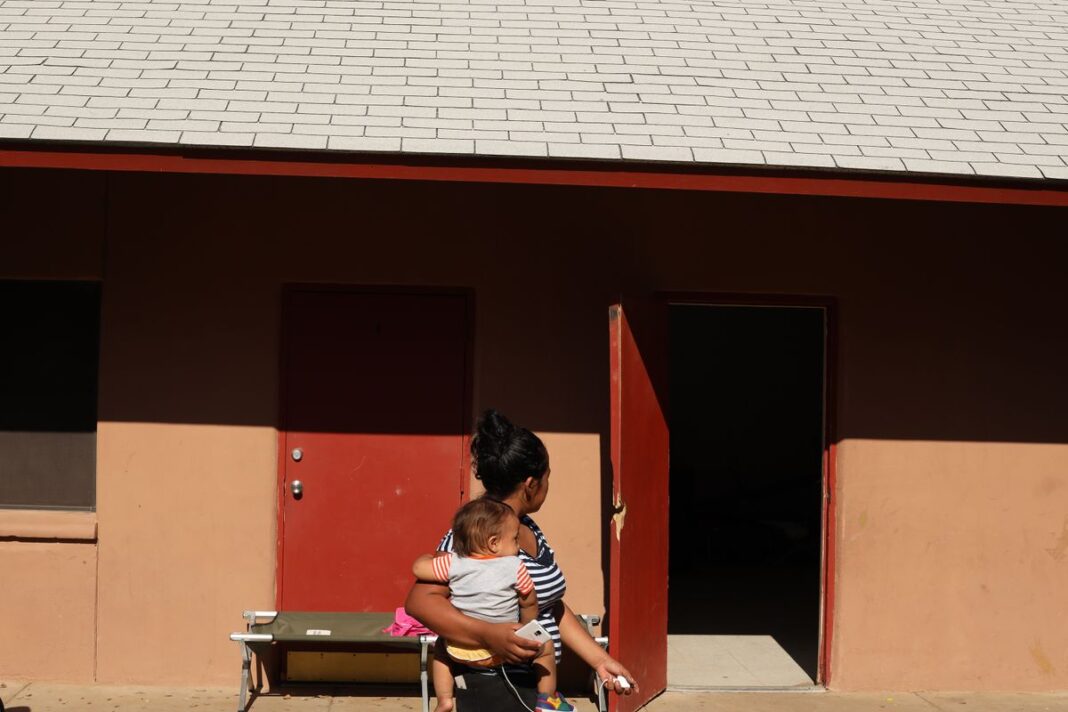
Kheilin Valero Marcano, Stiven Arrieta Prieto and their 1-year-old daughter, Amalia, felt overjoyed when, in early February, they were allowed to leave the Dilley Immigration Processing Center.
But after spending about two months locked in the prison-like detention facility for immigrant children and their parents in South Texas brush country, the family quickly faced new, unexpected challenges. They were driven more than an hour away to Laredo, on the north bank of the Rio Grande, and dumped at a shelter, with little more than the clothes on their backs. They were 600 miles away from where they had been arrested in El Paso. And even further from California, where they hoped to settle as their immigration case moved forward.
Last year, the Trump administration detained thousands of children like Amalia. Many were held in the detention center in Dilley, often for weeks or months at a time. Most of the people sent to the 2,400-bed facility were eventually deported to other countries. But 45% of them were released to await the outcomes of their cases in immigration courts, according to data obtained by the Deportation Data Project and analyzed by The Marshall Project. After leaving Dilley, families face the medical, psychological and financial repercussions of detention. And while they are relieved to leave the harsh conditions of detention, families say the release itself can also be harrowing.
Amalia’s family, who came to the United States from Venezuela in 2024, found themselves in Laredo without enough money for plane or bus tickets. The baby was still fragile, after spending over a week in the hospital with COVID and RSV, which had caused her oxygen levels to drop to dangerously low levels, according to court documents. According to the family’s lawyer, the baby was released from Dilley without her medications or key documents, like her birth certificate or vaccination records, which they were carrying when they were arrested.
CoreCivic, which operates the Dilley detention center, declined to answer questions but said it plays no role in decisions about a person’s deportation or release. The Department of Homeland Security also declined to answer a detailed list of questions about releases from Dilley, or about specific families’ claims about their detention. But a previous Homeland Security press release said that Amalia had received proper care.
In mid-January, the Holding Institute in Laredo got a call from Immigration and Customs Enforcement, asking about its capacity to host immigrants from Dilley, according to the Rev. Mike Smith, who runs the community center and shelter with a small staff. That same day, families started arriving at his doorstep by bus. They’d previously received people from Dilley, but in smaller numbers. For more than a month, he said, families have continued to be dropped off there, carrying only what belongings they had with them when they were arrested, weeks or months before. Some nights, 35 or 40 people arrived, typically confused and distressed.
“Their first question is usually one of two: Either, ‘Where’s the bathroom?’ or, ‘Do you have a place where I can plug in a phone to charge it?’” said Smith.
Many of the families, without money or paperwork to travel, stayed overnight at the shelter, which has 150 beds in its dormitories and picnic tables and chairs lined up in a windswept courtyard. Trains blaring horns pass right outside the perimeter wall. Smith said the Holding Institute doesn’t get funding from the government these days — nor from CoreCivic. Despite the expense, the Laredo charity’s leader said he doesn’t want to turn anyone away, nor to judge immigration enforcement authorities. “We chose to do this because we think it’s the right thing to do,” said Smith.
The families who arrived at the Holding Institute this winter, Smith said, started their journeys in countries across the globe — Russia, Cuba, Venezuela, Honduras, El Salvador, China, India. Some had lived in the U.S. for years. When they were let out of Dilley, they’d been given summonses to show up in court soon, usually near where they were arrested — sometimes hundreds, even thousands of miles away, Smith said.
That’s what he said had happened to an Angolan woman and her 6-year-old daughter who arrived from Dilley in mid-February. She’d been arrested while taking the girl to school, even though the woman had an active immigration case still unfolding in the courts. Smith said they had to try to figure out how to fly or take a bus home to Maine, more than 2,200 miles away.
Smith said when families arrived at the shelter, they were often bewildered by how and why they’d been arrested. Some questioned their faith. Many needed psychological care, but there was no time or resources to “open those kinds of mental wounds.” He said the immigrants want to get home quickly, to see if they still have jobs and if their children can go back to school.
“They are tired. They are tired. They are tired,” Smith said of the families. “You’ll see tears later, once they become aware that it’s safe.”
Valero Marcano, Arrieta Prieto and their daughter eventually made it to California with help from their legal team. The family spoke to The Marshall Project by video and asked that their exact location not be published, due to safety concerns. Their baby, who they described as joyful and mischievous, breastfed in her mother’s lap. She’d become more mercurial since being detained, crying when her mother left the room, even briefly.
Amalia and her parents, Kheilin Valero Marcano and Stiven Arrieta Prieto, were detained at Dilley Immigration Processing Center and then left at a shelter in Laredo earlier this year.
Elora Mukherjee, a lawyer for the family and director of the Immigrants’ Rights Clinic at Columbia Law School, said she has witnessed the long road families face after release. She said while detained, parents sometimes lost their jobs, apartments and cars. Many were placed on ankle monitors, which can make getting a new job difficult because of the stigma.
Mukherjee said many families she represents were arrested while showing up to ICE check-ins or immigration court dates, and were released from detention with their cases in the same position where they started, only now with the family in worse shape, mentally, physically and financially.
“They’re starting from square one again,” Mukherjee said.
Leecia Welch, chief legal counsel at Children’s Rights, a legal advocacy organization for young people, represents children in a class-action lawsuit over detention conditions. She said the fact that many families are arrested while trying to comply with court instructions, and then released with no changes to their cases, shows the haphazard nature of family detention under Trump.
“It boggles the mind why we’re disrupting people from their immigration proceedings only to abduct them, incarcerate them at Dilley, and then just recycle them out the back door,” she said.
According to the American Academy of Pediatrics, detention poses a threat to children’s health, and even short periods in immigrant detention can cause trauma and long-term mental health risks. The experience can also compromise family bonds. “Detention itself undermines parental authority and the capacity to respond to their children’s needs,” the academy and a coalition of other health organizations wrote in a letter to President Donald Trump and Homeland Security Secretary Kristi Noem last year.
One mother whom Mukherjee represented had a 9-year-old daughter and a 6-year-old son with leukemia. After they were released and returned to their home in California, whenever strangers walked by their apartment windows, the boy hid under the bed. If his mother made him leave the house, he’d sob and scream, terrified he’d be arrested. Eight months after his release from Dilley, he is still terrified when he sees a person in uniform.
Oksana, Nikita and their three children were released from custody at Dilley last month, after being arrested while seeking asylum at the Mexican border. The family requested their last name not be published because of fears of retaliation in their home country of Russia, if they are deported.
Oksana had seen her children suffer at Dilley over their roughly four-and-a-half months in detention. The rules were strict, and there was little to do. Her 4-year-old had asked if they were in jail because they were bad people. And the children resisted eating food after finding worms in it.
“They seem more adult-like and more serious and gloomy, and it seems unnatural,” she said.
But Oksana said the release process had been one of the worst experiences yet.
The family said they had been told they were going to be released, and managed to buy plane tickets to California for their anticipated departure date. They felt thrilled; Oksana heard joy in her children’s voices. But when they went to the door, she said they were told that they couldn’t actually leave, and no one would explain why. They lost the tickets, costing them $1,500, which they said was a major financial hit. Her 14-year-old son, who had been working hard to remain tough and stoic in front of his siblings, was so distraught that he said he wanted to hang himself if they didn’t get out.
Within a day, with help from friends, they were able to scrape together money for more tickets. This time, the facility released them, and they boarded a plane to California, where they planned to stay while their case progressed.
Oksana said her children were strong, and they were finding joy in the outside world, but she knew the road to recovery would be long.
She has lined up a doctor’s appointment for her 12-year-old daughter, who she said suffered hearing loss from what the family said was a poorly treated ear infection while inside Dilley. And she was working to get the children back in school, after receiving scant education inside.
“It’s going to take us, I think, quite a while, to return them back to life,” she said.