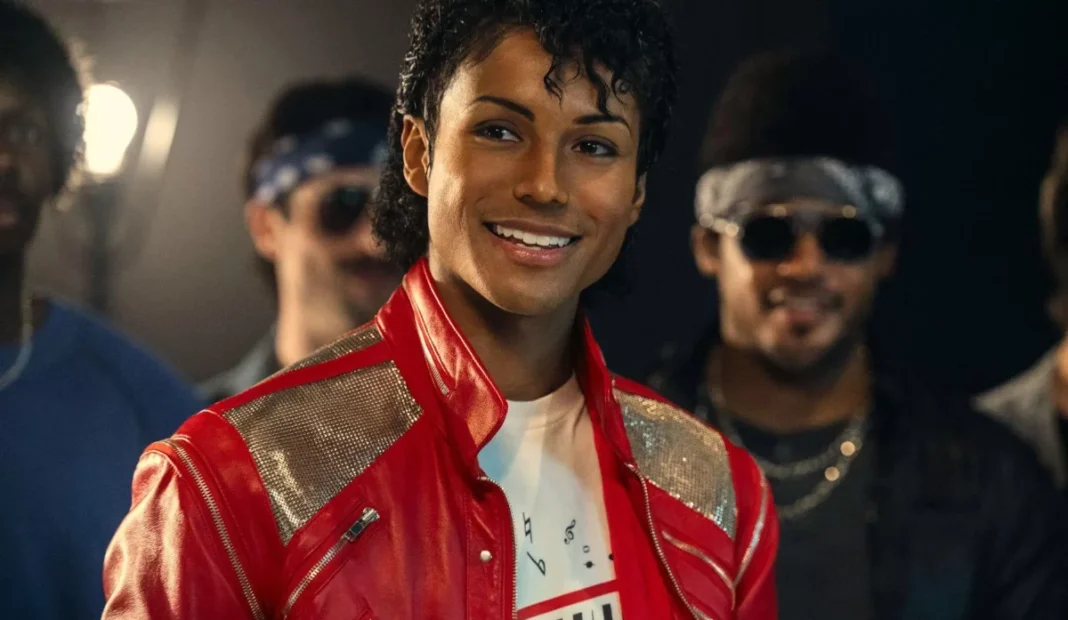

Antoine Fuqua’s Michael doesn’t just aim to tell the story of Michael Jackson; it sets out to recreate the feeling of experiencing him in real time. The result is a full-blown, must-see cinematic event, the kind of film that practically demands to be seen with a crowd of fans who already know every beat, lyric, and iconic move. From its opening moments, the film announces its intentions loud and clear, kicking off with “Wanna Be Startin’ Somethin’” and immediately immersing the audience in the electricity that defined Jackson’s artistry.
The first act wisely grounds itself in Michael’s origins, charting his early years in the Jackson 5 and the family dynamic that both shaped and scarred him. It’s here where the film finds some of its most compelling dramatic footing. Colman Domingo delivers a genuinely unsettling performance as Joe Jackson, portraying him not just as a strict patriarch but as an imposing, often frightening force. Domingo has proven time and again that he can tap into morally complex, even cruel characters, and this may be one of his most chilling turns yet.

The film doesn’t shy away from depicting the abusive environment Michael grew up in, and those moments can be difficult to watch, but they also serve as the emotional backbone of the story. The throughline of control, Joe’s relentless need to dominate his family, becomes the engine that drives Michael’s ambition, his perfectionism, and ultimately his need to escape.
Young Michael is brought to life with remarkable precision by Juliano Krue Valdi, who captures both the innocence and the incredible talent of a child already operating at a superstar level. Whether performing “I Want You Back” or “ABC,” Valdi embodies the charisma and showmanship that made the Jackson 5 such a phenomenon. These early musical sequences are bursting with life, staged with a vibrancy that feels like time travel.
As the film transitions into Michael’s solo career, Jaafar Jackson takes center stage, and it’s here that the film truly becomes something special. His performance is nothing short of transformative. The vocal work alone is impressive, achieved through a seamless blend of original recordings and Jaafar’s own singing. The transitions are virtually undetectable, preserving the authenticity of Michael’s voice while still allowing Jaafar to inhabit the role fully.

Even more astonishing is his physical performance. The precision, the fluidity, the almost supernatural control of movement, it’s all there. Whether he’s crafting the choreography for “Beat It” or bringing the legendary “Thriller” music video to life, the film is at its absolute best when it leans into these moments of pure performance.
And there are a lot of them. At times, the film unapologetically prioritizes spectacle over narrative momentum, stretching musical numbers out not because the story demands it, but because the audience wants it. Honestly? It works. These sequences are so electrifying, so meticulously crafted, that it’s hard to complain when the plot takes a backseat. This is a film designed for fans, and it understands that Michael Jackson’s music is the main attraction.
That said, the film’s biggest weakness is also hard to ignore: Michael feels undeniably sanitized… by design. With the involvement of the Jackson estate, the portrayal is carefully curated to present him in an overwhelmingly positive light. The film frames Michael almost entirely as a victim of his upbringing, of fame, of the pressures placed upon him, while avoiding any exploration of his controversies or personal flaws. Moments meant to humanize him, such as visits to children’s hospitals or quiet scenes at home, reinforce a singular image: Michael as a gentle, misunderstood figure.

While this approach aligns with the film’s celebratory tone, it also limits its depth. The narrative can feel one-note at times, lacking the complexity that defines the most compelling biographical dramas. There’s little sense of internal conflict beyond what was imposed on him by others, and as a result, the character risks feeling more myth than man. The estate’s involvement is also linked to a notable omission: Janet Jackson essentially does not exist in this movie at all, though her story is arguably enough for its own film.
Flawed, dazzling, and impossible to look away from — Michael is exactly the movie the estate wanted, and somehow still worth every minute.
Still, even when the storytelling feels safe, the craftsmanship and performances keep the film engaging. Nia Long brings warmth and empathy as Katherine Jackson, offering a quiet counterbalance to Joe’s harshness. And every time the film returns to the stage, it regains its pulse — those are the moments where Michael transcends its limitations, reminding us why Jackson remains such a towering cultural figure.
Ultimately, Michael succeeds as an experience. It’s a celebration rather than a deconstruction, sometimes to a fault, but a thrilling one nonetheless. For longtime fans, it’s a chance to relive the magic on a massive scale. For newcomers, it’s an introduction delivered with undeniable style and energy. Perhaps that’s exactly the point, because if this film proves anything, it’s that the legacy of the King of Pop is far too big for just one movie.
Grade: B
Follow us on MSN for more content like this.

Michael
Discover the story of Michael Jackson, one of the most influential artists the world has ever known, and his life beyond the music, tracing his journey from the discovery of his extraordinary talent as the lead of the Jackson Five, to the visionary artist whose creative ambition fueled a relentless pursuit to become the biggest entertainer in the world